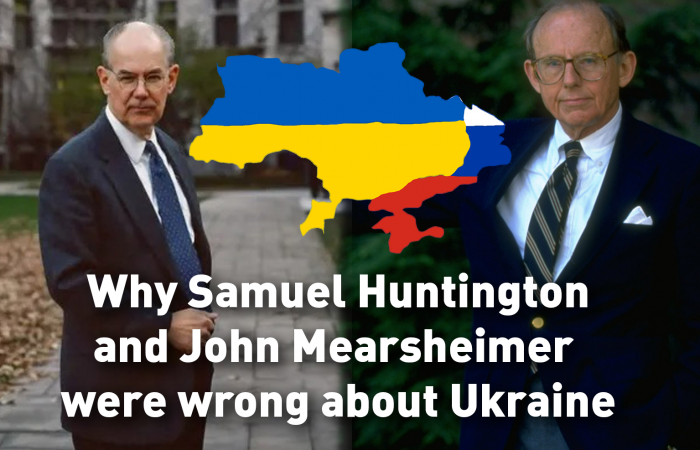
Why Samuel Huntington and John Mearsheimer were wrong about Ukraine
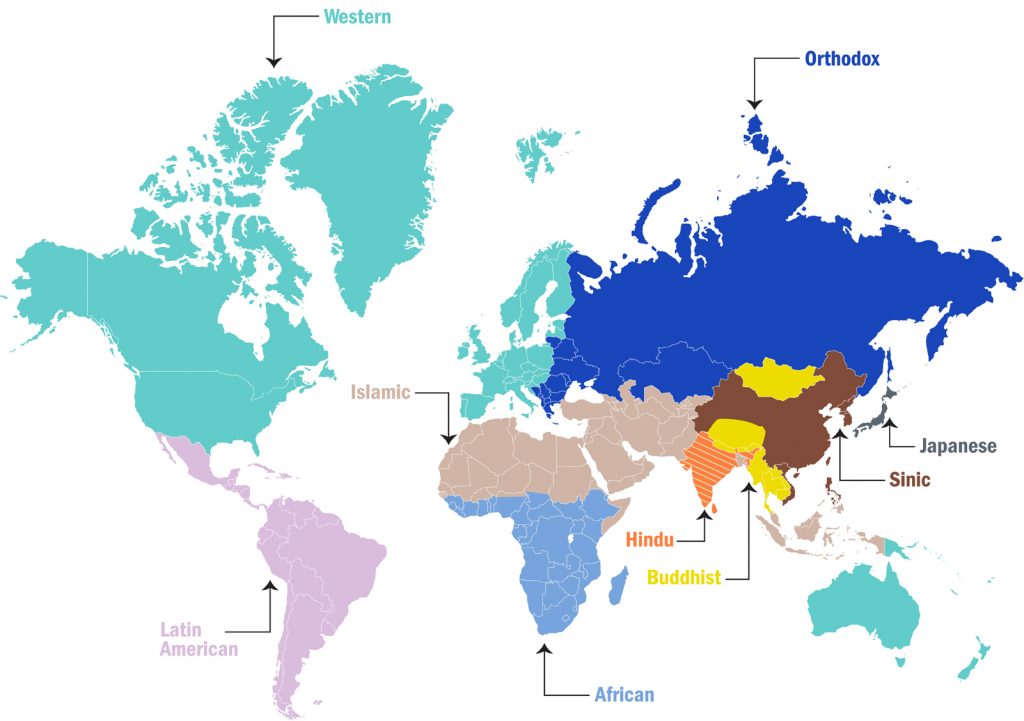
You may be familiar with Samuel Huntington’s book, The Clash of Civilizations and the Remaking of World Order. In this influential work, the author predicts how the world will evolve after the collapse of the Soviet Union and the end of the Cold War. Huntington identifies nine major civilizations – Western, Islamic, Sinic, Orthodox, Buddhist, Hindu, Latin American, Japanese and African – and argues that they will clash over cultural and ideological differences. In this article, I will challenge Huntington’s concept of civilizations by using the war between Russia and Ukraine, which are both part of the Orthodox civilization according to him, as a counterexample. I will also explain why John Mearsheimer – another geopolitical strategist – was right in 1995, but wrong in 2014.
1. Orthodox Civilization
“Several scholars distinguish a separate Orthodox civilization, centered in Russia and separate from Western Christendom as a result of its Byzantine parentage, distinct religion, 200 years of Tatar rule, bureaucratic despotism, etc.” Samuel Hungtington
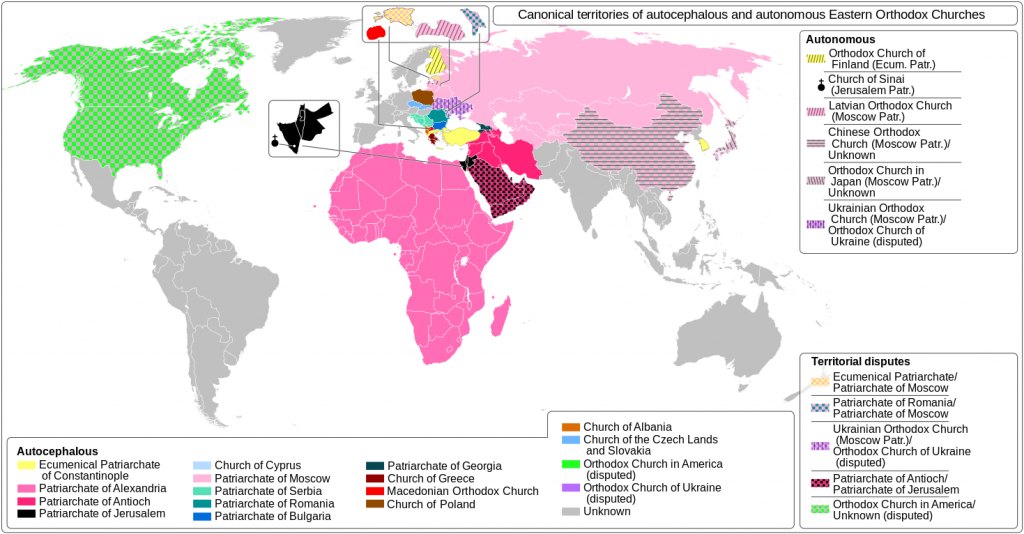
Christianity came to the Balkans, Bulgaria, and Kyivan Rus from Byzantium, and the Kyivan Metropolitanate was under the authority of the Constantinople Patriarchate. However, the Great Schism of 1054 divided the Christian world into Western Catholicism, centered in Rome, and Eastern Orthodoxy, based in Constantinople. The Ottoman Turks’ conquest of Constantinople in 1453 weakened the patriarchate’s supremacy and subjected many Orthodox churches, such as the Greek, Egyptian, Bulgarian, and Serbian ones, to Ottoman rule. Taking advantage of Constantinople’s vulnerability, Moscovia established its independent patriarchate in 1560 and became the fifth Orthodox Church by the 1590s. In 1687, Moscovia effectively took over the Kyivan Metropolitanate from Constantinople, gaining more influence in the Orthodox world.
The idea of the third Rome became very popular in Russia during this period. In 1523 and 1526, the monk Filofei of the Pskov-Eliazarov monastery declared –
“know that all Christian kingdoms ceased to exist and have merged into one kingdom of our sovereign… According to prophecies, this is the third Rome, two previous Romes’ have fallen, the third is standing, and the fourth will never come.”
This notion was revised in the sixteenth and seventeenth centuries. The third Rome refers to the doctrine that Russia or, specifically, Moscow succeeded Rome and Byzantium as the supreme power in the Christian world.
During the Russian-Turkish conflicts in the 18th and 19th centuries, Moscow grew even more powerful and earned the appellation of Orthodox Christians’ protector from Turks. Balkan states including Georgia, Serbia, Greece, Armenia, and others acquired independence from the Ottoman Empire throughout time.
It is not surprising that Samuel Huntington assumed that the Orthodox civilization is happily united under Russian control. Serbia, Armenia, and Greece are indeed long-term Moscow allies, but recent events show that the Orthodox world has its fault lines.
In 2008, Russia invaded Orthodox Georgia, in 2014, Russia attacked Ukraine – another Orthodox country, and in 2020, Russia refused to actively support Armenia during the second Nagorno-Karabakh conflict, even after President Pashinyan directly called for help.
On June 5th, 2017, Montenegro – an Orthodox country and also a long-term ally of Russia – joined NATO, despite Russia’s unsuccessful attempt to overthrow the government in Podgorica in 2016. Not to mention Orthodox Bulgaria and Romania joining NATO in 2004.
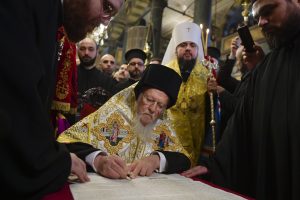
Another important fact to mention is the open conflict between Constantinople Patriarch Bartholomew I and Moscow Patriarch Kirill who compete for primacy in the Orthodox world. The Constantinople Patriarch is considered the first among equals in the Orthodox world, but Moscow tried to attract other Orthodox churches to their side and make the third Rome theory come true.
In 2019, Patriarch Bartholomew made an unprecedented step and granted the Tomos of autocephaly (decree of ecclesial independence) to the Ukrainian Orthodox Church, dealing a huge blow to Moscow’s ambitions and claim to Ukrainian territory.
This event might seem insignificant to Westerners, but it will have a huge geopolitical impact in Eastern Europe and the Orthodox world in the next centuries, as it exposed Moscow’s weakness, where religion serves the state.
Therefore, religion does not play a significant role in the relations of the Orthodox countries today. The Balkan states and Ukraine align with Western values, free market, and democracy rather than Russian authoritarianism. Even Armenia turned to the US for help and invited Nancy Pelosi after their presumed ally Moscow did nothing to help during the new outbreak of the Nagorno-Karabakh war. In the next decade, we will see Georgia, Ukraine, Moldova, and Armenia joining NATO and the EU, and maybe even Belarus, after Russia’s decline and collapse.
2. Ukraine is a torn country
In Clash of Civilizations, Huntington claimed that there are certain fault lines in every country and between different civilizations that can erupt in a conflict:
“At the local or micro level, fault line conflicts occur between neighboring states from different civilizations, between groups from different civilizations within a state, and between groups which, as in the former Soviet Union and Yugoslavia, are attempting to create new states out of the wreckage of old.”
Now, it is obvious that there are fault lines between states with different religions, like Armenia and Azerbaijan, or Israel and Palestine. But what about internal fault lines? They could be ethnic – like the Basques in Spain, or linguistic – like French and English-speaking Canada, or even political – like Democratic and Republican states in the US. Huntington claimed that there is a fault line running along the Dnipro River –
The civilizational approach focuses on the civilizational fault line that divides Orthodox Eastern Ukraine from Uniate Western Ukraine. While a statist (Mearsheimer’s) approach emphasizes the possibility of a Russian-Ukrainian war, a civilizational approach downplays that and instead emphasizes the possibility of Ukraine splitting in half, a separation that cultural factors would suggest might be more violent.
A second and more likely possibility is that Ukraine could split along its fault line into two separate entities, with the eastern one merging with Russia.
…violence between Ukrainians and Russians is unlikely. These are two Slavic, mainly Orthodox peoples who have had close ties for centuries and among whom intermarriage is common.
Samuel Huntington assumed that people from eastern Ukraine are closer to Russians than their fellow Ukrainians in the West. Ukrainians were indeed divided for centuries by the Russian Empire, the Polish commonwealth, the Austro-Hungarian Empire, Poland, and the USSR.
This is the map Elon Musk used to show the divide between western and eastern Ukrainians during the elections in 2012. It shows how eastern Ukraine voted for the pro-Russian Party of Regions. This map is supposed to be the “evidence” that Huntington’s fault lines dividing Ukraine are real. But what if we look at the US voting map – is this the fault line dividing Americans?
Of course, the differences in the countries can be and will be used to divide people. Huntington, influenced by the collapse of Yugoslavia, assumed that Ukraine would split, rather than go to war with Russia.
But he did not take into account the things that unite nations and not divide them. For Ukrainians, it is common history like Zaporozhian Sich – a uniquely European phenomenon of a free stratocratic protostate of Cossacks, the first university in Eastern Europe called Kyivo-Mohylian Academy, or the independence of the Ukrainian People’s Republic in 1919. It is also our culture, language, folklore, and cuisine.
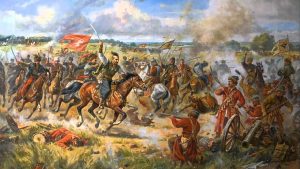
Huntington made a mistake by not taking into account values that transcend differences. National identity is more important to the Irish than the use of the English language. Common history and shared land are more important to Scots than their differences with Brits. American values are much more important to Democrats and Republicans – otherwise, the US would be torn by civil war.
And of course, nothing unites people better than a common enemy – even hardcore pro-Russian Ukrainians, seeing Russia’s barbaric acts of raping, executing, and bombing civilians, became Ukrainian patriots and nationalists like longtime Party of Regions politician and supporters of Russia’s mayor of Kryvyi Rih Oleksandr Vilkul, or Dobkin.
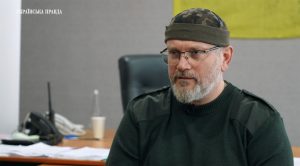
After what Russia did – we don’t have common past, we only have separate future Oleksandr Vilkul
3. Russia will not attack and Ukraine will be in it’s “sphere of influence”
“Ukraine will remain united, remain cleft, remain independent, and generally cooperate closely with Russia.
Russia are demographically mature societies with low birth rates and aging populations; such societies do not have the youthful vigor to be expansionist and offensively oriented.” Samuel Hungtington
So, as you can see, these statements are not even worth debating. They completely missed the mark. Huntington did not account for the Russian neo-imperialistic ambition that could lead to the terrible war that we have today.
4. How John Mearsheimer was right and wrong
Samuel Huntington challenged another geopolitical analyst, John Mearsheimer for his so-called statist approach and neglect of culture and civilizational ties.
“Many people thought the armed conflict was likely, which led some Western analysts to argue that the West should support Ukraine’s having a nuclear arsenal to deter Russian aggression. If civilization is what counts, however, violence between Ukrainians and Russians is unlikely.
A civilizational approach emphasizes the close cultural, personal, and historical links between Russia and Ukraine and the intermingling of Russians and Ukrainians in both countries and focuses instead on the civilizational fault line that divides Orthodox eastern Ukraine from Uniate western Ukraine.”
But check what John Mearsheimer wrote in 1993 and was right–
“the situation between Ukraine and Russia is ripe for the outbreak of security competition between them. Great powers that share a long and unprotected common border, like that between Russia and Ukraine, often lapse into competition driven by security fears. Russia and Ukraine might overcome this dynamic and learn to live together in harmony, but it would be unusual if they do.
Ukrainian nuclear weapons are the only reliable deterrent to Russian aggression. A conventional war between Russia and Ukraine would entail vast military casualties and the possible murder of many thousands of civilians.”
John F. Mearsheimer, “The Case for a Ukrainian Nuclear Deterrent: Debate”, Foreign Affairs, 72 (Summer 1993), 50-66.
But in 2014 John Merscheimer presented a different view which was repeated by Jordan Peterson and other Western conservatives over and over again:
“The United States and its European allies share most of the responsibility for the crisis. The taproot of the trouble is NATO enlargement, the central element of a larger strategy to move Ukraine out of Russia’s orbit and integrate it into the West.”
Why the Ukraine Crisis Is the West’s Fault: The Liberal Delusions That Provoked Putin John J. Mearsheimer Foreign Affairs
So, essentially, Mearsheimer concurred with Huntington that Ukraine belongs to the Russia-centered Orthodox civilization, and the West should leave Ukraine to the Russians and let them do as they please with it.
“This is Geopolitics 101: great powers are always sensitive to potential threats near their home territory. Russian leaders have told their Western counterparts on many occasions that they consider NATO expansion into Georgia and Ukraine unacceptable, along with any effort to turn those countries against Russia -a message that the 2008 Russian-Georgian war also made crystal clear.” John F. Mearsheimer
But as we have seen recently, NATO enlargement to Sweden and Finland did not bother Moscow at all. Russians did not threaten to attack Helsinki, which remained neutral for 70 years, they just kept quiet about it. So having NATO at their borders is not the issue, or Russia can only wage wars on weaker countries like Georgia and Ukraine. The intellectuals and politicians in the West seem to have forgotten the famous George Kennan’s long telegram, which accurately predicted the behavior of the Soviets and the effective way to deter them in the future Cold War –
“Soviet power is impervious to logic of reason, and it is highly sensitive to logic of force. For this reason, it can easily withdraw and usually does when strong resistance is encountered at any point.
Gauged against Western World as a whole, the Soviets are still by far the weaker force. Thus, their success will depend on the degree of cohesion, firmness, and vigor which Western World can muster.” George Kennan
Until now, the West was listening to Mearsheimer and Huntington, leaving Ukraine to the mercy of Russia. This is why Ukraine was barred from entering NATO due to Angela Merkel’s and Nicolas Sarkozy’s objections in 2008. Thanks to the fierce resistance of Ukrainians, the Western establishment is slowly turning back to Kennan’s forgotten axiom – “Russia is highly sensitive to the logic of force”. Therefore, Ukraine will undoubtedly win and become a part of NATO, the European Union, and Western Civilization as a whole, turning away from the Orthodox and Moscovite spheres of influence.
Ivand Fedorych 2023